


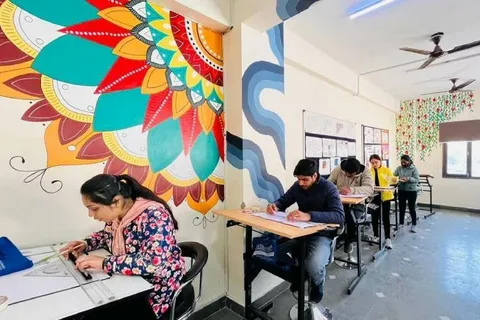
Students may see how classical design features interact with modern buildings and economic growth. It may inspire students to play with materials, shapes, textures, layouts and visual ideas and establish their own design identity via this exposure.
The appropriate setting to learn interior design may make a huge impact to a student’s creative and professional growth. A good learning environment should inspire experimentation, but also educate practical skills, technical knowledge, design thinking and professional discipline.
Creativity, along with systematic interior design course in Jaipur instruction, may progressively guide students to develop their ideas into concepts that are esthetically attractive, functional, sustainable and suited for real-world needs.
Understanding the Interior Design Creative World
Interior design is a combination of many different and seemingly unconnected fields of study. A designer must grasp color theory, space planning, furniture, lighting, materials, textures, architecture, ergonomics and visual composition. At the same time, designers must comprehend the needs of the individuals who will utilize a certain area. A beautiful room cannot be a successful interior if it is unpleasant or impractical.
This balance between creativity and utility is one of the most significant topics in interior design education. Students learn to look beyond the adornment to understand why certain design choices are chosen. They could think about how natural light penetrates a room, how furniture impacts mobility, how color affects perception, how materials work in various situations and how rooms might be arranged according to their function.
Education in interior design may also provide students exposure to many forms of design and historical influences. Studying traditional Indian interiors, modern minimalism, contemporary design, sustainable interiors and foreign trends will provide learners with a wider visual vocabulary. Students will be inspired by Jaipur’s rich creative legacy with the opportunity to experience traditional craftsmanship and recreate it via modern design ideas.
This blend of inspiration and practical knowledge is necessary for the aspiring designer. Students may learn to investigate, analyze, create, test and express creative ideas rather than just replicate established styles. This technique develops confidence over time and helps kids learn about their own abilities as creators.
Why Jaipur Is An Inspiring Place To Study Design
How pupils see creativity may be influenced by the environment where they learn. Jaipur has a particular design environment where traditional architecture, handicrafts, contemporary structures, hospitality spaces, retail areas and residential projects all co-exist. This enables one to see the range of approaches to color, proportion, materials, decoration, construction and spatial organization.
The architecture of the city might be especially beneficial for those interested in Indian design. Traditional structures show how courtyards, arches, patterned surfaces, natural materials, ornamental features and climatic concerns may be combined into architecture and interiors. At the same time, the new developments bring in current planning principles and evolving living needs.
The contrast may prompt students to explore crucial design issues. How do you bring old workmanship into contemporary homes? How does a modern interior represent the identity of the place? How can designers incorporate historic patterns without making a place seem dated? How do contemporary materials play with natural textures? These questions assist students learn to think more thoughtfully about design.
Jaipur is also associated with a vibrant ecosystem of crafts and creative pursuits. Textiles, ceramics, woodwork, metals, masonry, surface ornamentation and other traditional crafts may introduce students to concepts for material research. Future designers might create more significant ideas by learning how materials are manufactured and utilized, rather than thinking of them as just ornamental finishes.
Hence, studying interior design in such an atmosphere might help to take learning beyond classrooms. Everyday environment may become sources of inquiry, observation, inspiration and experiment. Technical understanding is the key to turning an abstract vision into a functioning interior. Understanding the constraints of materials, dimensions, structure, lighting systems, furniture proportions, and circulation needs helps students to make concepts that are beautiful and feasible.
Learning Via Projects, Experimentation And Practical Exposure
Maybe the most essential thing in design school is a chance to learn via projects. When students use interior design principles in actual circumstances it becomes simpler to comprehend. Project-based learning enables students to try out these ideas in actual design situations, rather than just memorizing color theory or spatial layout from a textbook.
Students may work on several sorts of spaces, therefore learning progressively how design needs alter with function. A restaurant is not a bedroom, an office is not a retail shop or hospitality facility. Each project raises fresh concerns about circulation, furnishings, lighting, privacy, branding, materials, user behavior and upkeep.
Design projects may also motivate the pupils to go through several phases. They may start with research and mood boards, then go on to conceptual sketches and space planning, followed by detailed drawings, material palettes and visual presentations. This technique helps students learn that good design doesn’t usually come from a single concept. It often comes about via observation and experimenting, feedback, revision and refining.
For practical experience may also allow pupils to realize professional objectives. Working to briefs, deadlines, presentations and project requirements develops organization and discipline. Positive criticism may help students learn how to analyze their work and develop without losing the original creative vision.
This project-based approach may be very effective for developing a portfolio. A portfolio shows not just the result of a project but the designer’s ability to study, generate concepts, solve space challenges and express ideas.
A well-structured interior design curriculum may expose students to such aspects as space planning, furniture layouts, lighting design, materials, construction procedures, color schemes, architectural features and design documentation. Students learn these basic concepts so that they understand how a thought may be evolved from an initial idea into a complete proposal.
Finally
Digital technology has also become a significant aspect of modern design work routines. Students of interior design course in Jaipur use computer-aided design, three-dimensional modeling, rendering, presentation software and other digital resources. They may assist individuals to see areas before they are built, and to convey ideas to customers, builders, architects and other experts.
But technology should complement creativity, not replace it. A software tool can assist produce a sketch or representation, but the designer still has to define what the space is supposed to say and how it’s supposed to perform.
